Hi folks!
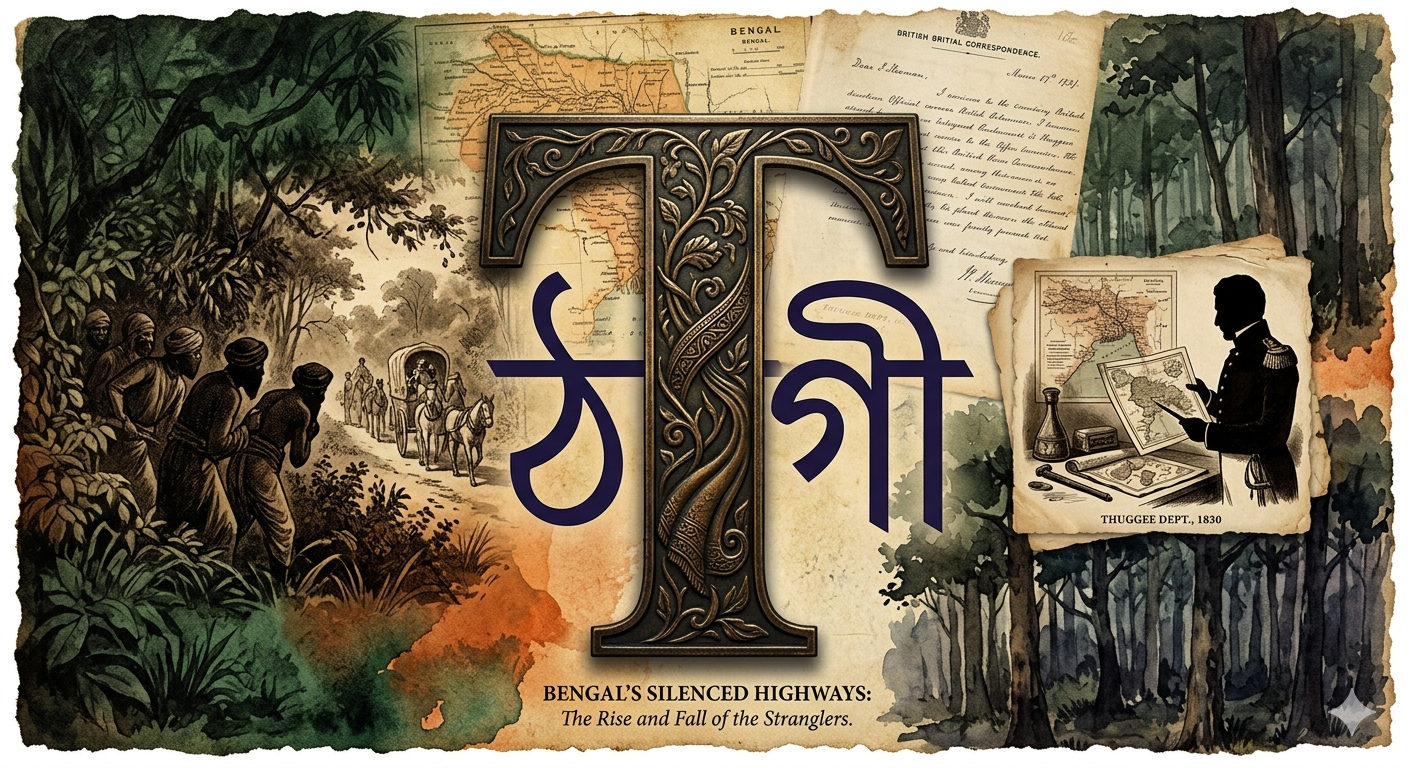
Most English readers will be familiar with the word “thug” and its meaning of a rough, violent person, especially a bully or a criminal. What few know is that the word arrived into English from Sanskrit via Bengal! Behind today’s generic muscled goon is a terrifying criminal phenomenon that forced the British in India to sit up and take notice. Though the original word meant “to deceive”, deception was only the beginning of the game for the thugs who became legends that plagued the British Empire for decades.
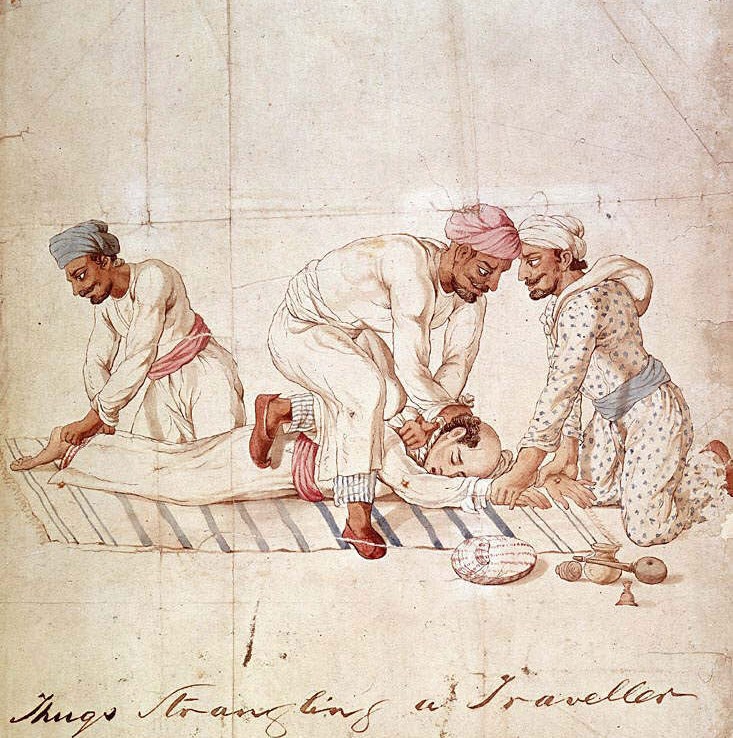
Imagine a lonely traveller on the road—a pilgrim or travelling merchant or sepoy. He is insecure and a little scared. He comes across a group of friendly strangers who welcome him with open arms, sharing their food and fire. After a while, he starts feeling drowsy. Then, one of his new companions points up at something. He raises his head to see. Before he can understand what is happening, he finds himself choking, a weighted handkerchief inexorably tightening around his neck. By the time he realises he has become a victim of thugee, it is too late.
Thugs—or murderous bandits with a similar modus operandi—are mentioned as early as 15th/16th century by Sant Surdas. From the 17th century onwards, there are several mentions of such criminals in various sources both Indian and European. The British colonials first encountered it in the early 1800s, and made several futile attempts to curb it until William Henry Sleeman’s campaign, about which we’ll talk a little later. What is clear that thugs had existed across the length and breadth of India for many centuries.
In the face of that, it is a little hard to imagine them as a secret cult of Kali worshippers, which was how the British colonials painted them. To have sustained their practices throughout the country and for a period of time that was longer than many empires without their identities being discovered would have required a level of organisation that is truly mind-boggling! It is far more likely that while local gangs of thugs might have been close-knit and well-organised, thugs as a whole likely weren’t so, unless of course, they were India’s version of the Knights Templar or Freemasons! Now, that’s an idea that historical thriller writers out there can run with. Any takers?
Though the popular image of thugee (the practice of the thugs or the crime committed by them) is by means of a weighted handkerchief only, in truth, thugs used other weapons just as much, including knives, swords, or poison. Even when strangling their victims, they would use anything that served the purpose, such as cords, clothing, or a wrap. When attacking groups, thugs murdered every member of the party to ensure there were no eyewitnesses. Their victims were either thrown into a well or ditch, or buried.
There are several theories regarding why they preferred strangulation of their victims over bloodshed, though the modus operandi is more myth than truth due to its appeal to the imagination. One theory links it to the Mughal legal loophole that allowed stranglers to not be given capital punishment. Another gives it a ritualistic angle, tying it to the worship of Goddess Kali by the thugs. Much of this idea, along with the spread of the idea of thugee as a cult, was the product of British colonial perspective and propaganda.
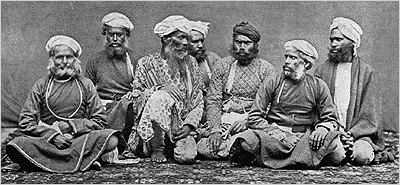
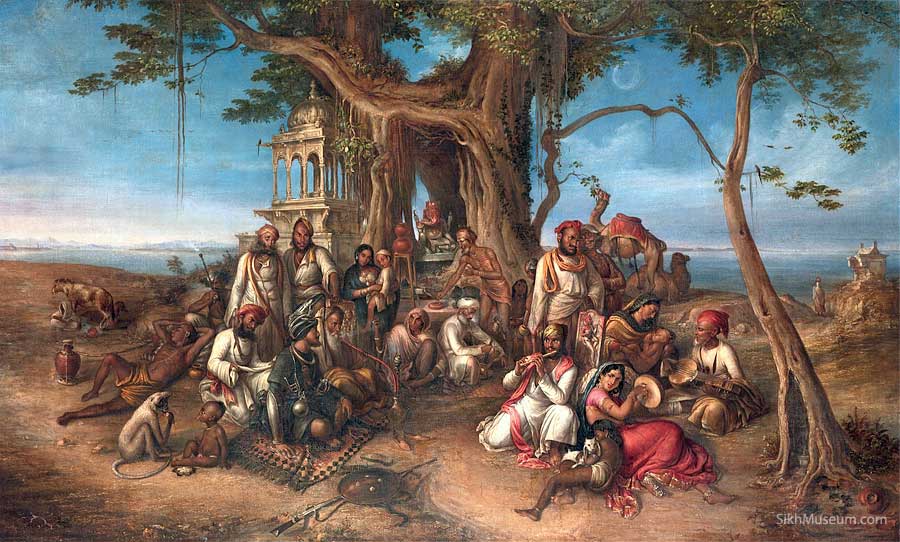
The thugs did worship the Devi in different forms, and even Muslim thugs worshipped her (which baffled the British officer interrogating them), but it is more likely the result of Devi worship being a common religious practice in ALL the local Hindu population. Thugs also believed in the Islamic concept of fate. In short, the thugs were a brilliant example of religious syncretism that the British police force could neither understand nor digest. Even more ironically, it is quite possible that the connection between thugee and religion was completely non-existent and was purely a product of colonial propaganda. At this remove of time, and with history being written by the colonials who were in power, it isn’t easy to separate fact from fiction where thugs are concerned.
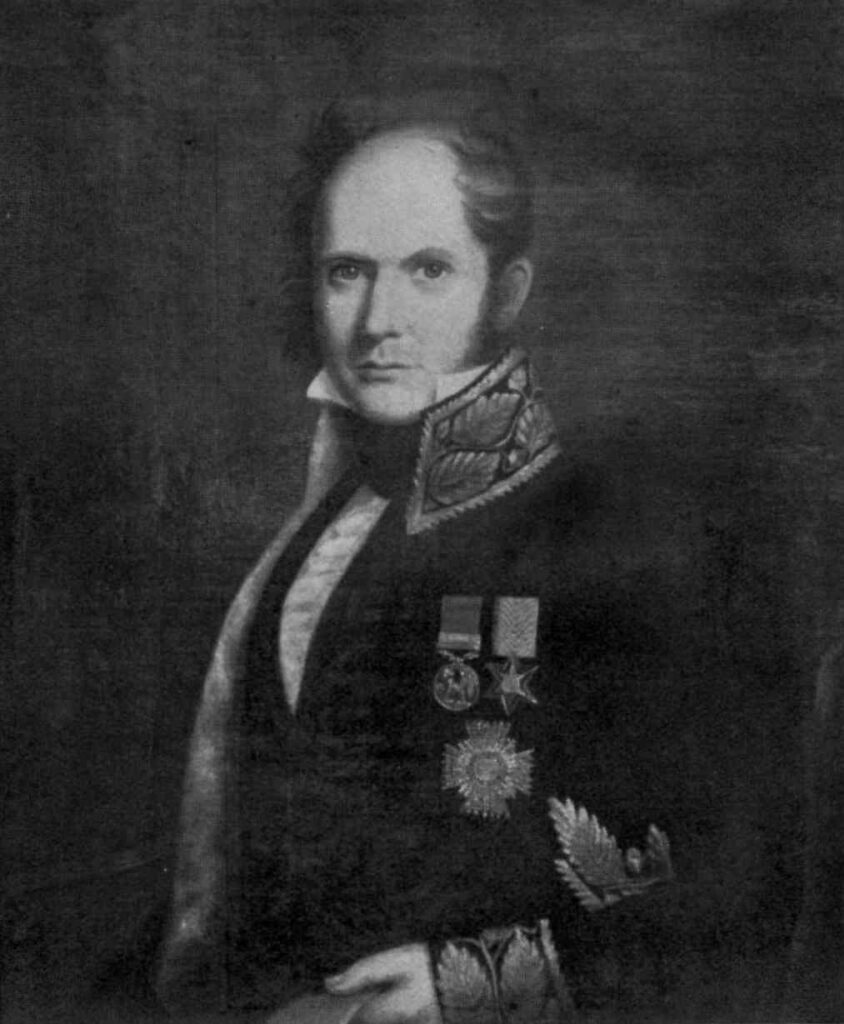
After thriving for centuries, the thugs finally met their match in William Henry Sleeman. He launched a large-scale organised campaign against them in the 1930s that was intelligence-driven and centralised. It was one of the first systematic anti-organised crime initiatives in the history of police work. He used “approvers” (thugs who turned government witnesses in exchange for immunity or leniency) as the primary weapon of his campaign. He also built a huge archive of paperwork including extensive records, genealogies, and maps under the Thuggee and Dacoity Department (created by him in 1935). He used a carrot and stick policy most effectively to root out, arrest, convict, and punish thousands of thugs. Within a decade, Sleeman and his team had broken the back of thugee as an organised activity. Epic Channel has an excellent program on this campaign that you might wish to check out.
Popular fiction and modern modes of storytelling have been fascinated by thugs almost as much as by pirates. Many 19th century authors, especially British ones, including Jules Verne and Conan Doyle, included thugs as characters in their books. Interest in thugs might have waned for authors in the first part of the 20th century, but returned with a vengeance in the latter part, with a Thug villain Ravan even appearing in the pages of DC Comics. Films and television too have depicted thugs in various capacities, though usually as antagonists, from mid-20th century onwards. Perhaps the bizarre and secretive nature of thugee, along with the almost-mystical legends that have grown up around the practice, make it such an enticing element for fiction.
In Ageless Feud, too, there is a mention of thugs, though indirectly. In a story that Manik Choudhury tells the Historian, he talks about his grandfather and a British colonial who went hunting together. Thugs are mentioned in the context of this story, though Manik makes a shocking observation about their involvement. Given how fascinating thugs and their practices were, I’m not sure I’m done with them. Even if I don’t include them in further books of City of Kaali, I might use them in some other story. Whether that materialises or not, only time will tell!
#AtoZChallenge
#BlogchatterA2Z
#Kolkata
#cityofkaali
#thugs
This post is a part of Blogchatter A2Z Challenge 2026



Leave a Reply