Hi folks!
The word “Panchali” has been made popular by Ray’s movie Pather Panchali. The title is translated into English as “Song of the Road”. However, Panchali isn’t just a “song”. It is a very specific kind of religious lyrical narrative that is recited during ceremonies and festivals. One of the most well-known of these is the Lokkhir Panchali (Panchali of Goddess Lakshmi) that I grew up watching my mother recite every Thursday, while doing a more elaborate puja than the daily worship of the household pantheon, and Lokkhi Pujo.
I’ve always been fascinated by the oral narrative traditions of our country. Long before writing made them more accessible, moral fables and stories—and even our epics—were circulated among common people through oral narratives and songs. The Lokkhir Panchali contains an anthology of several of these stories along with descriptions of how to worship the goddess the right way. Essentially, the Panchali is a summary of what people need to do and not do in order to invite Goddess Lakshmi into their lives and homes.
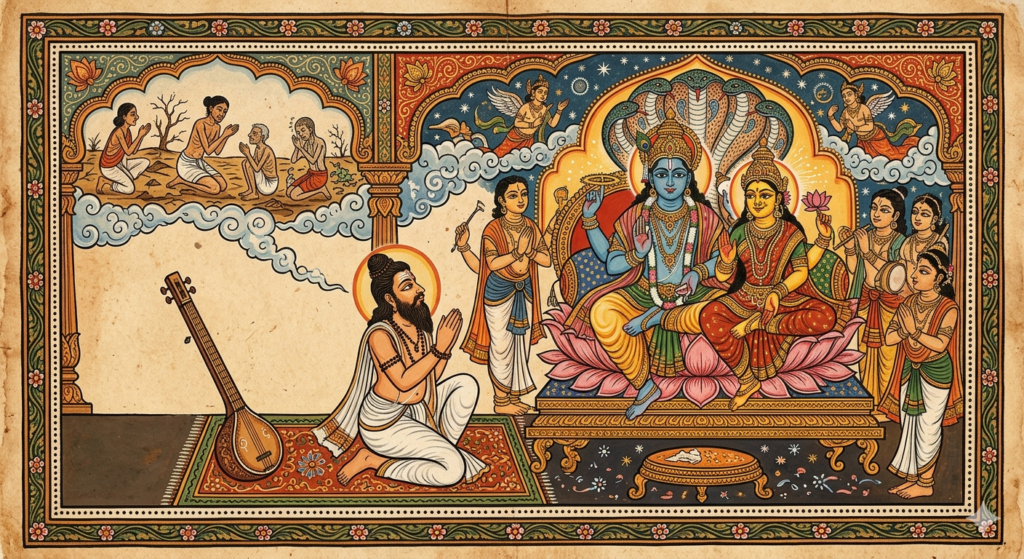
The Lokkhir Panchali starts with Sage Narada approaching Goddess Lakshmi and Shri Vishnu is Vaikuntha. He tells them about the miseries being faced by humans on earth. There is plague, famine, disease, and death. People are no longer doing good deeds. They are abandoning their families. Even suicide is being committed. He requests Goddess Lakshmi to help the humans as all the problems are an obvious manifestation of the absence of Lakshmi in people’s lives.
She replies that this is the consequence of people’s own misdeeds as they have forgotten about devotion and Laksmi. They behave in a way that has caused their downfall (sounds oddly contemporary and relevant, doesn’t it? But I’m digressing). However, she is finally convinced by Shri Vishnu to give humans a second chance. He is also moved by the plight of the humans and suggests a Thursday worship ceremony called Lokkhibrata to cleanse evil and restore prosperity.
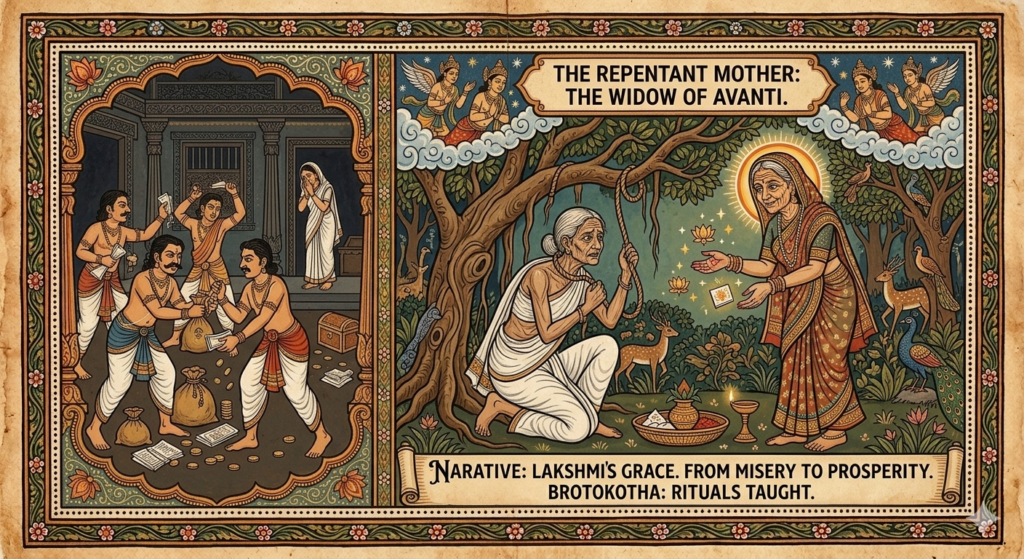
Another story tells of the meeting between Goddess Lakshmi and a widow. The Goddess descends to earth and travels to the city of Avanti disguised as an old woman. Her purpose is to find someone who is worthy of her benevolence and grace. There, in a forest, she encounters a weeping and miserable widow who is contemplating suicide. The Goddess stops her and asks what is wrong. The widow explains how everything in her life has been ruined; her seven sons fight with each other over the inheritance of their father, their wives also quarrel with each other, and there is no longer any prosperity or peace in her family.
The goddess comforts the widow and tells her what is to be done to undo the miserable situation. She teaches the widow the Brotokatha, the set of rituals and ceremonies to be performed during the Thursday-wise Lokkhibrata. She instructs the widow to go home and convince her sons and daughters-in-law to start doing the Brata as well. The widow follows her instructions. Under her guidance, the younger generation also starts observing the proper rituals. Soon, all the disharmony and problems in the family vanish and prosperity returns.
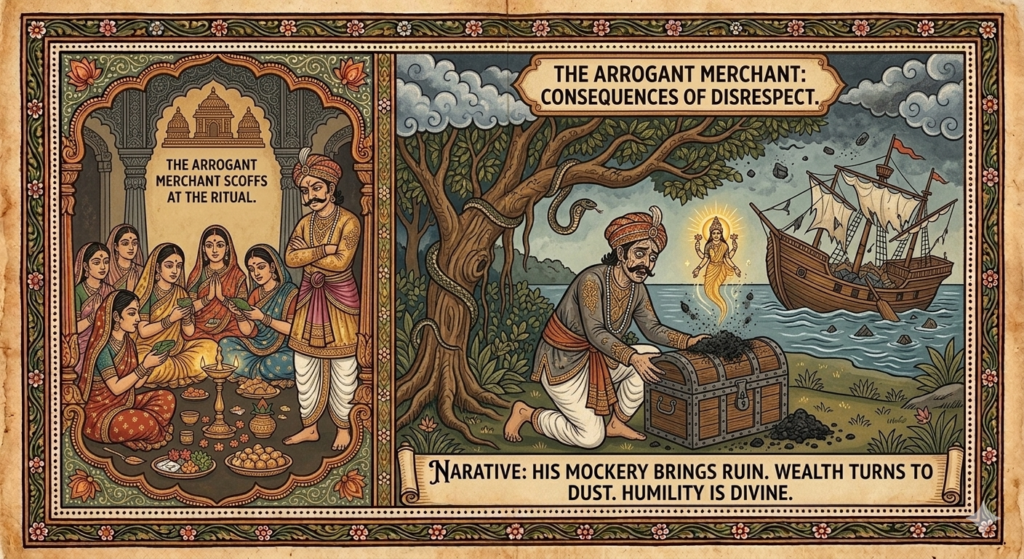
Another story is that of the arrogant merchant. A merchant sees a group of women performing Lakshmi Puja and upon learning that it is to grant prosperity, calls it a useless ritual. He declares that his wealth is the result of his own efforts and has nothing to do with Lakshmi. This angers the Goddess, and she abandons him. Soon, his business goes bust, his ships sink, his wealth is stolen, and he becomes a beggar. Realising his mistake, he repents and returns to the women who had been conducting the rituals. He learns from them and conducts the rituals with true devotion. Goddess Laksmi is appeased and returns to him, which leads to a return of his wealth and prosperity as well.
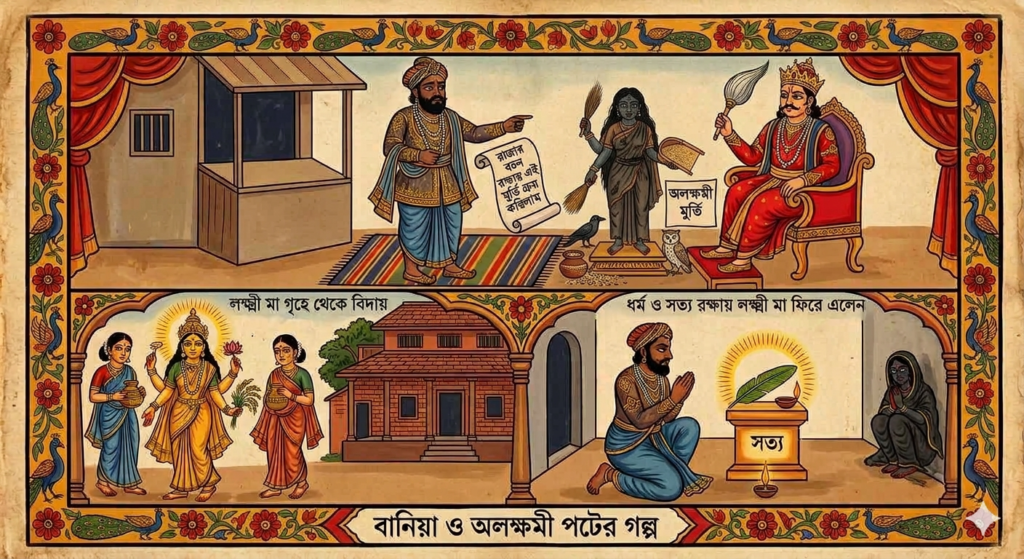
Another merchant in the Lokkhir Panchali who learns his lesson the hard way is the one who installs a statue of Alakshmi in his home. Having promised a king to buy whatever he sells, he buys the strange statue and brings it home. Lakshmi cannot abide its existence, so she leaves. Soon after, Success and Dharma also leave. When Truth is leaving, the merchant protests, saying he never abandoned Truth. His commitment convinces Truth to remain. As a result, Dharma also returns. Lakshmi and Success finally return as well once Alakshmi leaves.
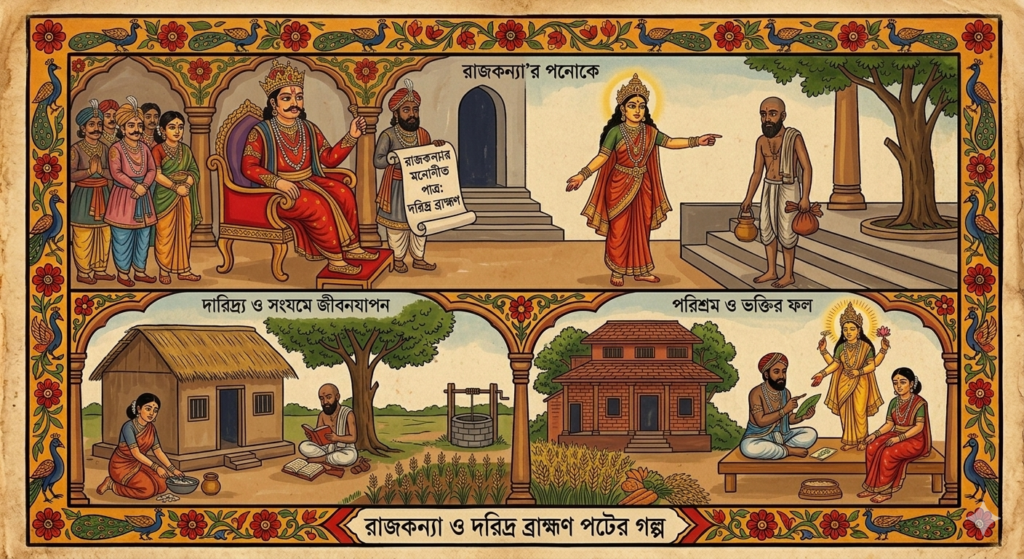
My favourite story from the Panchali is probably the one of the King’s Daughter and the Poor Brahmin. An arrogant king asks his children whose blessings enable them to live a life of prosperity and comfort. All except his youngest daughter praise him. The youngest daughter says that their prosperity is the result of Lakshmi’s blessings. Angry at her response, he decides to wed her to a destitute and sickly Brahmin, thinking that it will teach her a lesson.
Instead, once the princess starts performing the Lokkhibrata at her poor husband’s house with whatever alms they can gather. Slowly, things start to improve. Her husband regains his health, they become wealthy, their house turns into a palace. All this while, her father and her siblings lose their own prosperity and become destitutes. One day, they arrive at her house as beggars and are astounded by her circumstances. She looks after them kindly and teaches them the Bratakatha, which restores their fortunes as well.
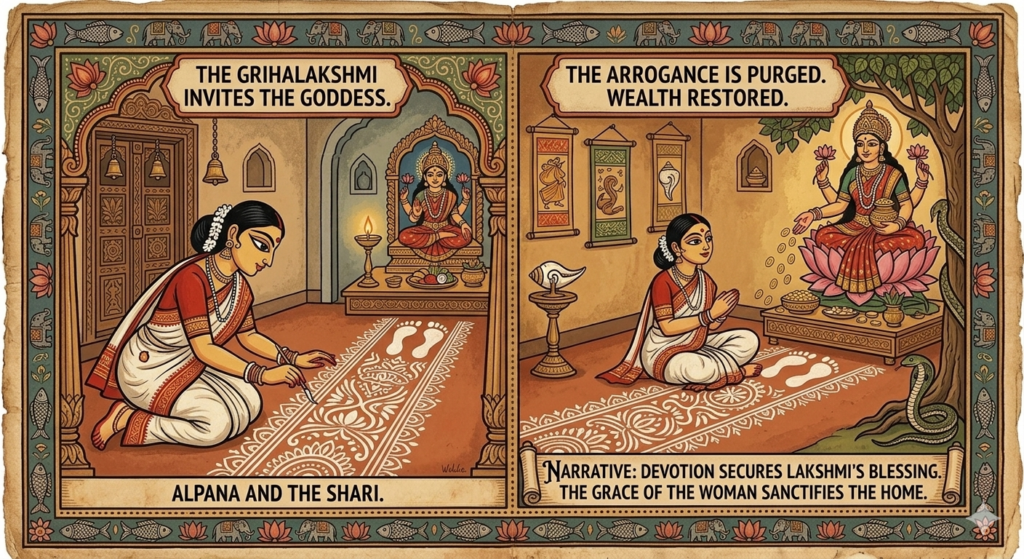
Apart from the stories, the Lokkhir Panchali also contains the details of the rituals to be observed—the actual Bratakatha. It establishes that the true way for bringing and keeping Laksmi in the house is through cleanliness, order, devotion, and care. It lists the different practices that the Grihalakshmi, the lady of the house, is expected to perform in terms of cleanliness and preparations. There is also a focus on the importance of order and discipline in the household.
Even apart from the religious implications, it is interesting that the Panchali talks about actions that can lead to a less chaotic and systematic way of life, which is definitely something that can contribute to bringing prosperity and joy. I am fascinated by how folk traditions are rooted in simple practicalities of life that are presented as religiously significant behaviour. Perhaps it was the lack of education that compelled it. Perhaps whoever came up with the idea was well aware of people’s tendency to refuse actions based on logic while following religious precepts to the T! Whatever the reason, I feel that the Lokkhir Panchali certainly has lessons for all of us even today, and even for those who (like me) are not religious.
#AtoZChallenge
#BlogchatterA2Z
#Kolkata
#cityofkaali
#lokkhirpanchali
This post is a part of Blogchatter A2Z Challenge 2026