Hi folks!
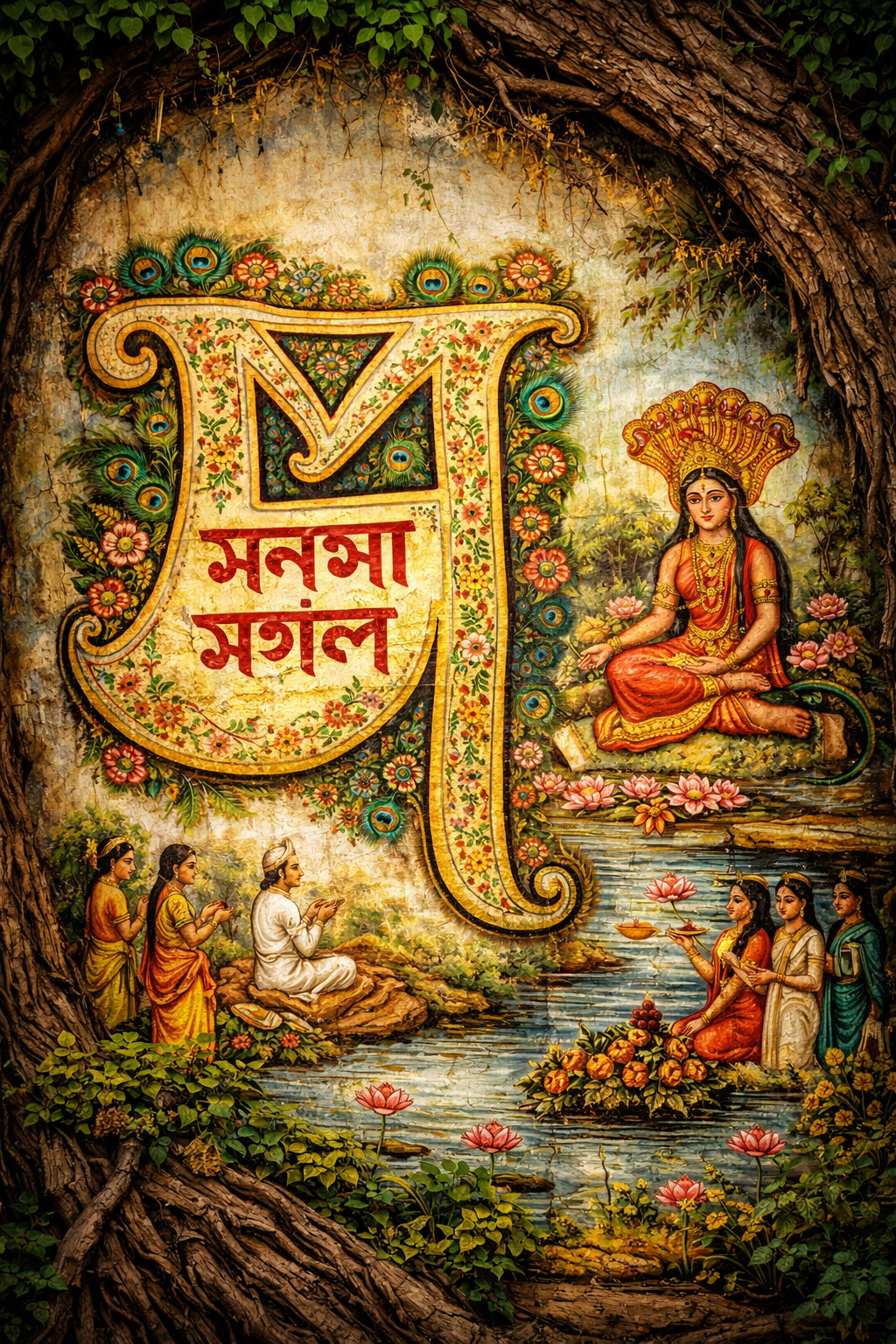
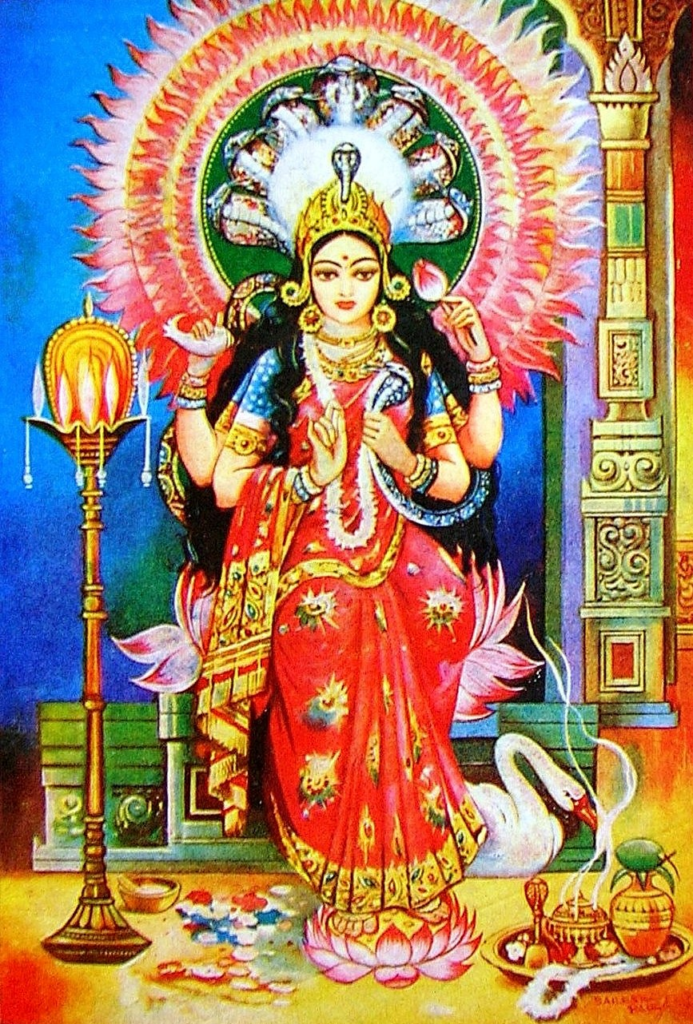
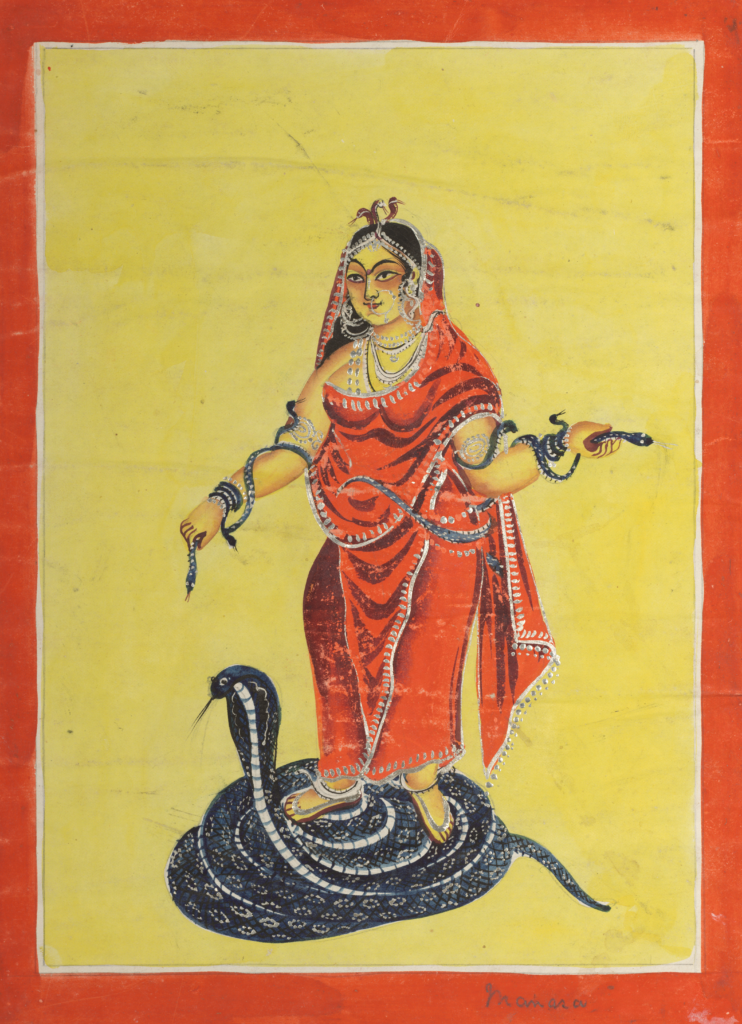
In my Baro Mashe Tero Parbon post, I mentioned Manasa Puja as one of the thirteen parbons. The goddess of snakes, Manasa, is a fascinating goddess who is very popular in Bengal. Interestingly, unlike most of the better-known gods and goddesses of the Hindu pantheon, Manasa is an indigenous goddess rooted in Bengal’s agrarian heritage. How she came to be worshipped historically is something that needs a deeper explanation; for now, let us dive into the Manasa Mangal Kavya which describes the myth of how she came to be worshipped.
The Manasa Mangal Kavya is part of the tradition of Mangal Kavyas (poems of benediction), Bengali religious texts in verse form, often dedicated to indigenous gods and goddesses, written between the 13th and 18th centuries. The Manasa Mangal is considered the oldest of these, with the Chandi Mangal Kavya and Dharma Mangal Kavya being the two other most prominent ones. Do note that these aren’t specific, single texts; rather, they are like sub-genres. While the core theme and story remain the same in the various kavyas, the details and style differ.
So, there isn’t a single Manasa Mangal Kavya but rather several written by different poets. The earliest of these is likely to have been Kana Haridatta (13th century) but his text is now lost. In the 15th century, Bipradas Pipilai, Purushottam, Bijay Gupta, and Narayan Deb wrote their own versions of the Kavya. Both Bijay Gupta’s and Narayan Deb’s versions are also known as Padmapuran. Ketakadas Kshemadnanda and Jagajjiban Ghoshal contributed to this Kavya in the 17th century, and in the 18th century, Jibankrishna Maitra and Jagmohan Maitra also added to it.
The story of the Manasa Mangal Kavya goes like this: Chandradhar or Chand Sadagar is a renowned devotee of Lord Shiva. Goddess Manasa decides that if he worships her too, her worship will become popular. However, he not only refuses to worship her but insults her as “Chyan-muri kaani” (One-eyed wretch). In her anger, she destroys his seven ships and kills his six sons. The youngest son, Lakhinder, is married to Behula, but he too is killed by snakebite on their wedding night.
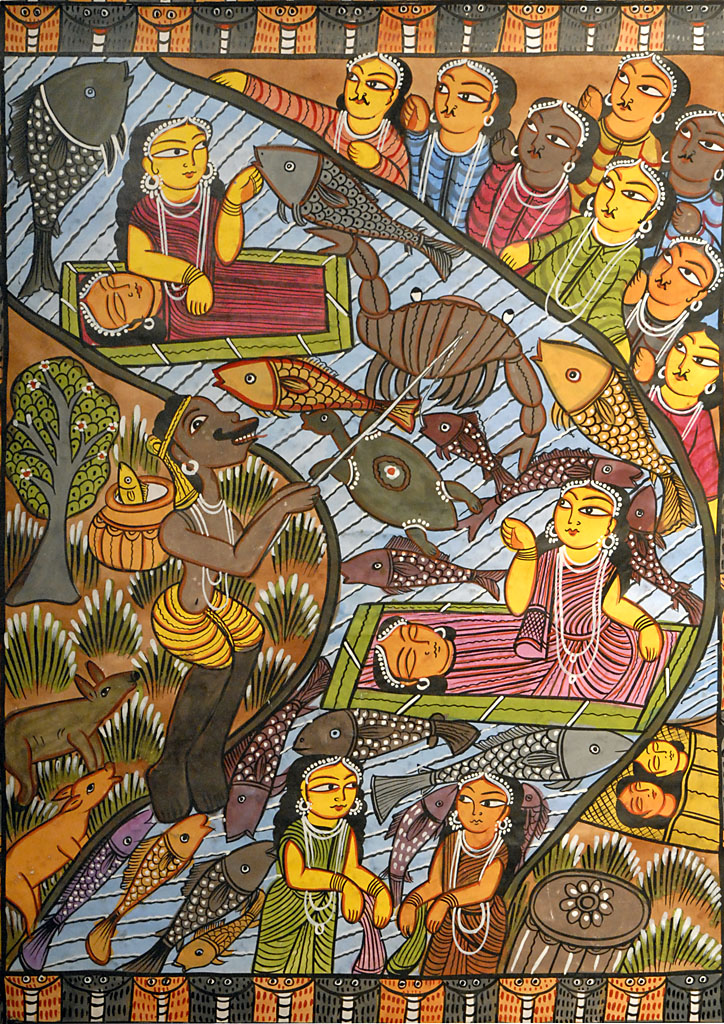
Behula refuses to accept her plight, and travels with Lakhinder’s body on a banana-pith raft to heaven. She faces many difficulties along the way, but succeeds in convincing the gods to have pity on her. Finally, Goddess Manasa agrees to relent and make reparations, but only if Behula convinces Chand Sadagar to worship her. Behula succeeds in doing this, and Chand offers a flower to Goddess Manasa with his left hand and his face turned away. Though still far from what was expected, this is considered acceptable by the goddess who returns Chand’s sons and prosperity.
There are many debates and discussions regarding the themes and significance of this Kavya. One of these is the issue of feminist ideals—Manasa, the headstrong feminine power taking on the patriarchy vs Behula, the compliant and devoted wife fighting for her husband and his family. Personally, I feel that both these characters have certain traits in common that are more relevant to their role as feminist icons. They are both determined to reach their goals, they are persistent and unmovable even in the face of insults and hurdles, and they will do almost anything to achieve their objectives. Though their values, goals, and methods differ, they are almost mirror images of one another in their stubborn determination. Rather, they are two sides of the same coin.
The other important theme is that of the emergence of indigenous gods in competition with Vedic gods. Despite opposition, the native Goddess manages to secure a victory over the Vedic God whose worship is more popular. Not only that but she also becomes established as a major deity of the region. In a way, it is also a reflection of the rural-urban divide in Bengal’s socio-cultural landscape.
On a slight tangent from these discussions, I am fascinated by the marketing and branding implications of this story. It is, in a way, the story of a small brand trying to establish itself in the market by convincing the ambassador of a large brand to endorse it. It is a story of brands, market share, and celebrity influencers, when seen from that perspective. These are such modern ideas that coming across the same concepts in a text that was written centuries ago is jaw-dropping. In an age where retellings are becoming increasingly popular, maybe someone should write this story!
#AtoZChallenge
#BlogchatterA2Z
#Kolkata
#cityofkaali
#manasamangalkavya
This post is a part of Blogchatter A2Z Challenge 2026