Hi folks!
I first heard of the term Nakshi Kantha as a child. Surprisingly, the source was not a discussion of handloom or heritage but rather one of the songs from the Buddhu Bhutum audio drama (I have mentioned this in my post on Folk and Fairy tales of Bengal). In the song, the princess mentions that her home is beyond Nakshi Kanthar Math (the field of the Nakshi Kantha). But what is Nakshi Kantha and what is the field of Nakshi Kantha?
Before discussing Nakshi Kantha, let us take a look at Kantha. It is a kind of embroidery born in rural households of Bengal, passed down from mother to daughter, as a means to recycle old clothes into something useful like a quilt or a baby’s bedclothes. One of the oldest forms of embroidery in South Asia, it originated as a measure of domestic frugality. Women used to stitch together old sarees or dhotis using the loose, long running stitch (called Kantha Sticth) to make it more functional as well as pretty to look at. Colours like red, blue, black, green, etc were used to embroider on a white background.
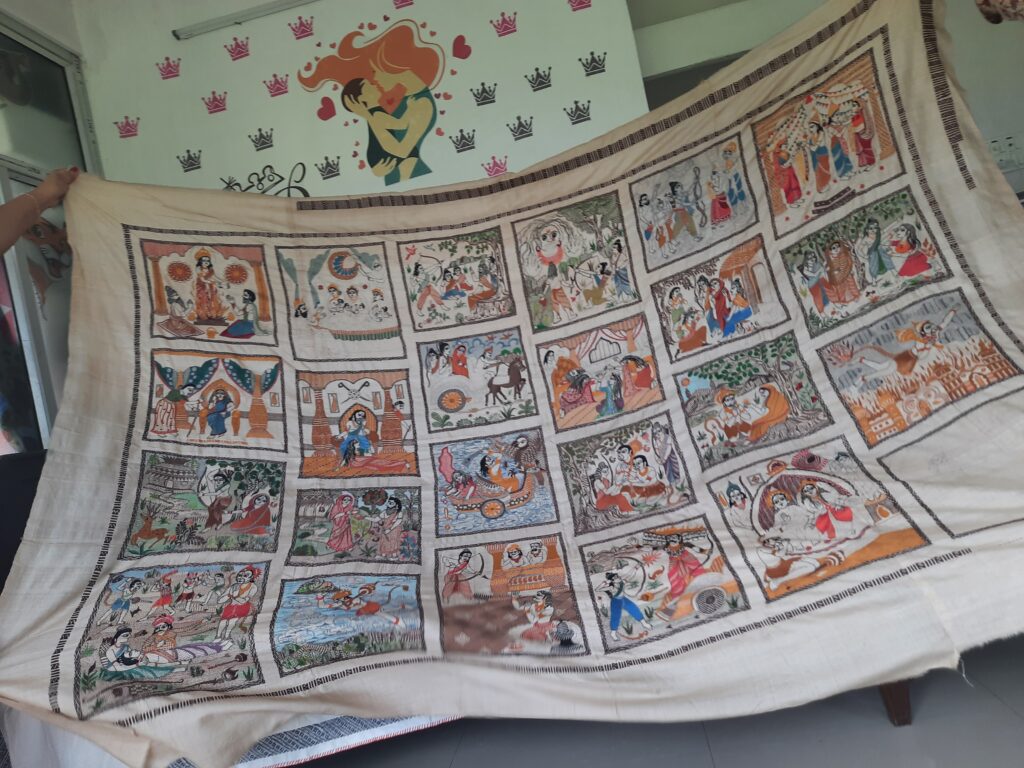
Now, coming to Nakshi Kantha, it is a highly intricate and complex variant of kantha where specific colourful patterns and designs (called “Naksha”, which give the name to the art form) are embroidered onto the kantha. Traditional designs include motifs from everyday life, birds, animals, fish, and plants. Since this type of Kantha requires complicated embroidery of many patterns, hand-embroidering a single Kantha would take women months.
Before we go further into the discussion of Nakshi Kantha, let me also explain the concept of the field of Nakshi Kantha. Although the audio drama mentions it, the written version of the story in the Thakurmar Jhuli does not. My guess is that its use in the recorded song is inspired by the well-known narrative poem Nakshi Kanthar Math by poet Jasimuddin (1928). It is a tragic love story where the heroine embroiders all the grief of her life onto a Nakshi Kantha, which is later placed on her grave. This gives the field where she is buried the name Nakshi Kanthar Math (The field of the embroidered quilt).
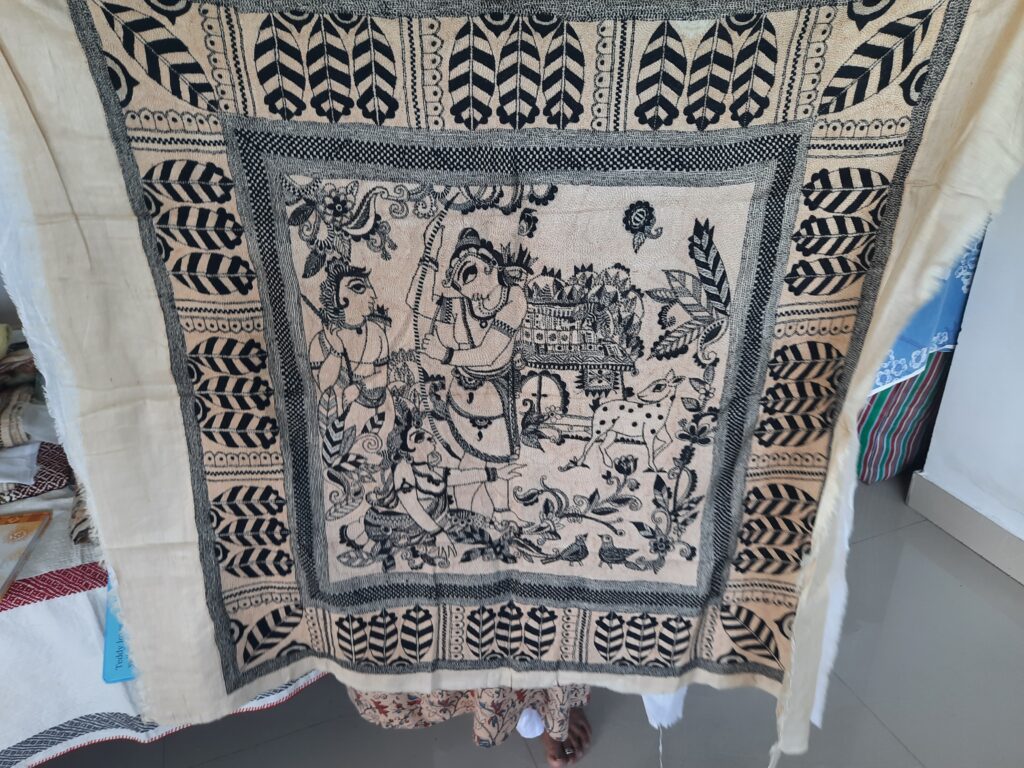
Regardless of how or why the expression was included in the audio drama of Buddhu Bhutum, the name itself left an indelible impression on my young mind, an image of something fantastic and magical. And truth be told, watching the intricate and beautiful patterns of a Nakshi Kantha unfold before my eyes holds that same sense of wonder and magic even in real life. This is an experience I had in 2022 during my visit to Kolkata, during which I met National Awardee and Shilpaguru Mrs Mahamaya Sikdar. A warm, lovely person and a pioneer in the field of Nakshi Kantha, she was kind enough to talk to me about her art and also show me several of the magnificent pieces she had crafted.
A brief digression is necessary at this point, I feel. Some of you might have noticed that I haven’t mentioned my series City of Kaali in the last couple of my posts. That has been unfortunately necessitated by the desire to avoid spoilers. But I can mention how Nakshi Kantha is related to the series in a spoiler-free manner. In Ageless Feud, I was fortunate enough to include the character of the Historian based on a real person, Dr Purabi Roy, one of the most brilliant minds of our times. She was generous enough to not only allow me to include her as a character but also to run an eye over the relevant portions to give me her blessings before publication. While I can’t tell you exactly how Nakshi Kantha enters the story, I confess that I would be greatly honoured if Mrs Sikdar allows me the same kindness that Dr Roy did.
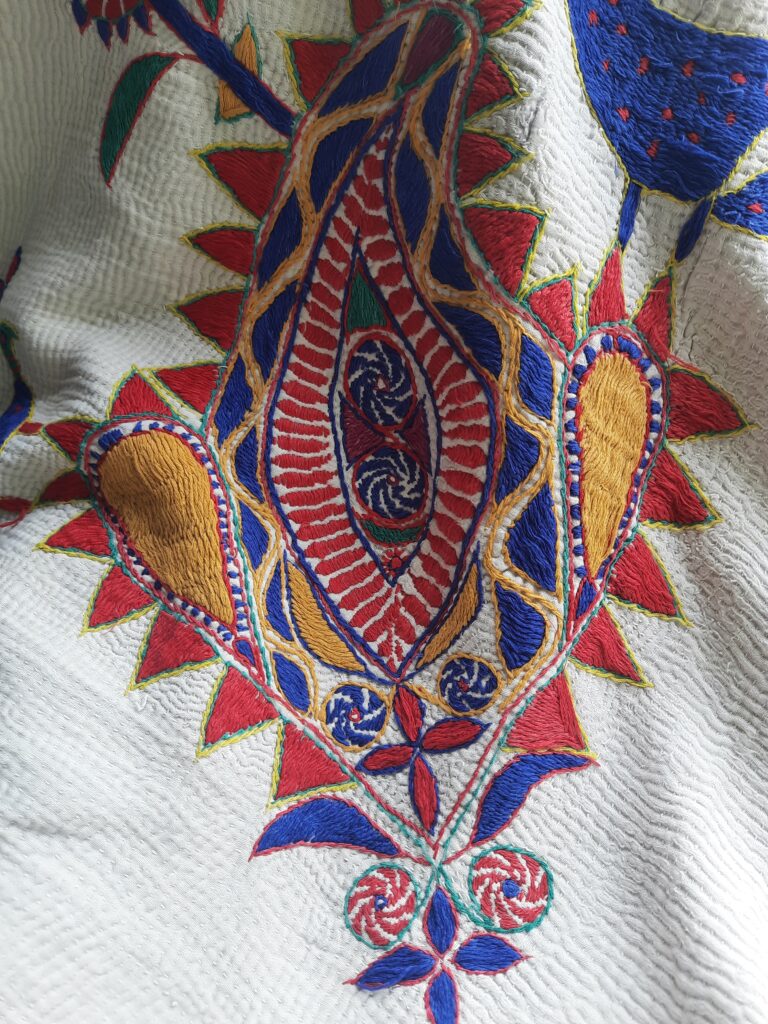
To return to Nakshi Kantha, today it has evolved from a utilitarian object that gave rural semi or illiterate women a space to express themselves to a true art form that received a GI tag in 2007. These days, Nakshi Kantha is embroidered on fresh cloth with a wide variety of fabrics being used, such as cotton, silk, organza, etc. The finished product is no longer restricted to use as a domestic object; rather, Nakshi Kantha graces bedcovers, tablecloths, items of clothing, shawls, and many other items of décor or fashion. While traditional designs and patterns continue to be embroidered, Mrs Sikdar has revolutionised the artform with her use of abstract designs that reflect our modern realities in much the same way that traditional designs reflected the lives and themes of the original artists of the Kantha.
There is so, so much to be said about this marvellous art form, but for once, I’d rather let the images do the talking while I sit by spellbound in admiration at what human imagination, skill, and diligence can give birth to. Do you own any piece embellished with Nakshi Kantha? If you do, please share in the comments. If you don’t and would like to own something, also let me know in the comments. I will redirect you to Mrs Sikdar under whose tutelage, many underprivileged women now earn a living through this wondrous artform.
#AtoZChallenge
#BlogchatterA2Z
#Kolkata
#cityofkaali
#nakshikantha
This post is a part of Blogchatter A2Z Challenge 2026
Comments
2 responses to “N is for Nakshi Kantha”
I have always been mesmerised by Kantha. As someone who is fond of doing embroidery, I have always dreamt of doing a project using Kantha stitch, but am yet to gather the courage to do so. Loved this post
I’ll be very happy to connect you with Mrs Sikdar. She is a wonderful lady who loves to teach the art to others. As someone who is absolutely awful at embroidery despite having ancestresses who embroidered like magic, I am in awe of anyone who can create this art or any embroidery art.